bootsonground
The Community Wall Effect: Building Behavioral Safety Through Peer Engagement (2026)
Safety culture cannot be built with a policy document. The Community Wall turns peer recognition, Good Catches, and resolved hazards into a self-sustaining loop that keeps your workforce engaged and reporting.
 ISO 27001
ISO 9001
ISO 20000
ISO 27001
ISO 9001
ISO 20000
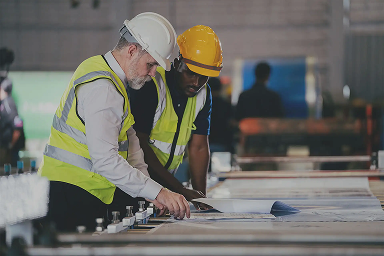
The Community Wall is a workplace safety engagement feed where workers post Good Catches, share resolved hazard photos, and recognize each other for safe behavior. It works by applying behavioral science principles including social proof, peer recognition, and visible feedback loops to build a proactive safety culture from the ground up. Sites using BootsOnGround's Community Wall report a 3x increase in near-miss reporting within the first 90 days.
Why Technology Alone Cannot Build a Safe Workplace
AI risk scoring and QR zone inspections are powerful tools. But they only work if workers actually use them. And workers only use them consistently when they trust that the system works for them, not just against them.
Traditional EHS platforms are built like enforcement tools. They record failures, assign corrective actions, and generate compliance reports. From a frontline worker's perspective, the system exists to catch mistakes. The predictable result is minimum compliance. Workers do what is required and nothing more. Near-miss reporting stays low. Hazard observations go unsubmitted. The leading indicator data that AI needs to predict risk never gets generated.
When psychological safety is high, only 3% of employees plan to quit their organization compared to 12% when it is low. The same principle applies directly to safety reporting. When workers feel psychologically safe to report hazards and near-misses without fear of blame or punishment, reporting rates rise dramatically and so does the quality of risk intelligence across the facility.
The Community Wall is designed to create that psychological safety through behavioral science, not policy mandates.

From Police to Peer: The Social Proof Principle
The most durable behavior change in any workplace comes not from corporate directives but from social proof, which is the human tendency to align behavior with what peers around us are doing and valuing.
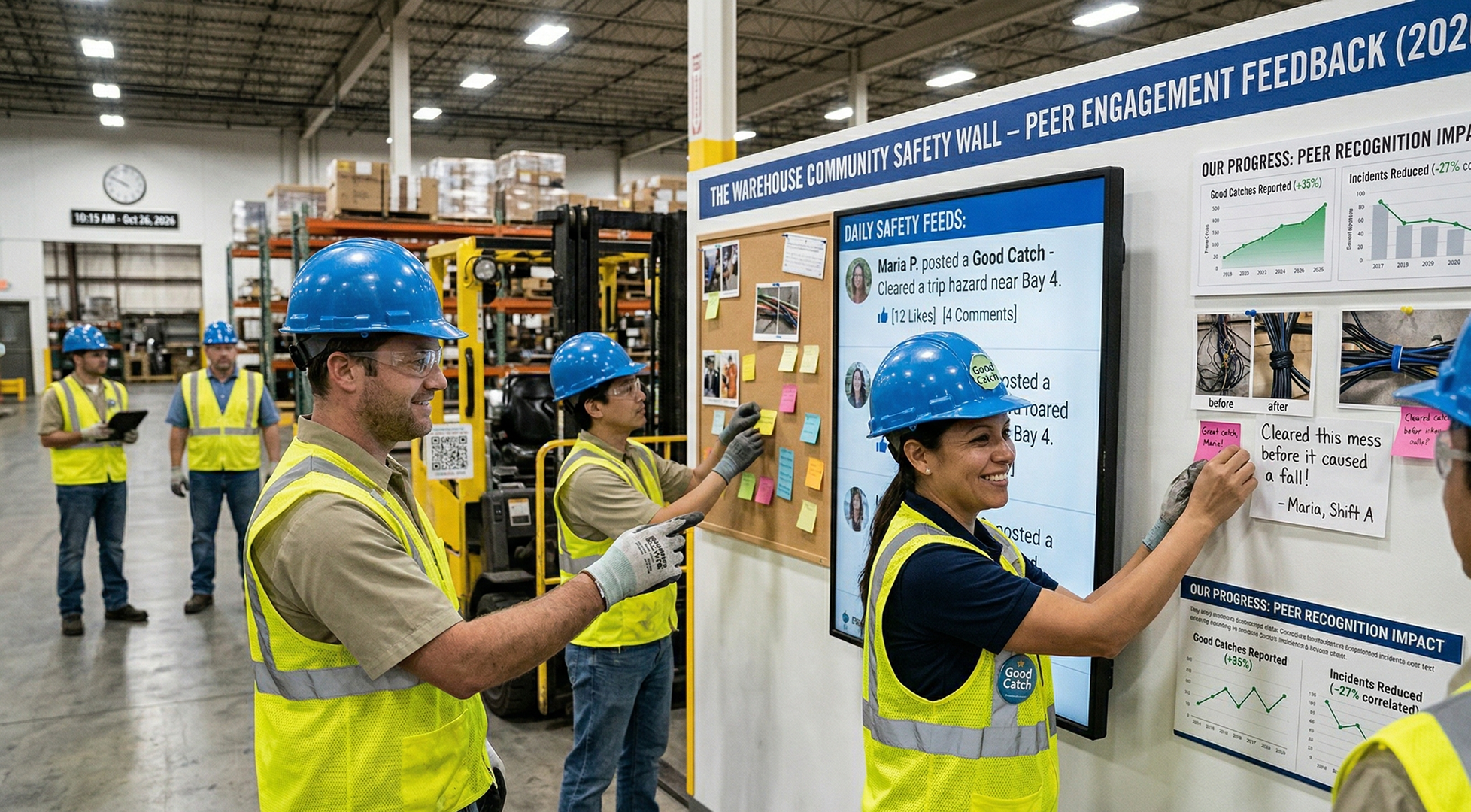
When a worker posts a photo of a trip hazard they cleared before their shift, and three colleagues respond positively, two things happen. First, the reporting worker receives positive reinforcement that makes them more likely to repeat the behavior. Second, every worker who sees that post receives a social signal that proactive safety behavior is something their peer group values and recognizes.
92% of employees say they are more likely to repeat a behavior they were recognized for, and peer-to-peer recognition is 35.7% more likely to drive positive outcomes than manager-only praise
This is the behavioral mechanism behind the Good Catch culture. Every Good Catch posted on the Community Wall is not just a compliance record. It is a social signal that reinforces safe behavior across every worker who sees it, without a single management directive being issued.
In manufacturing specifically, regular recognition correlates with a 27% reduction in safety incidents, and organizations where recognition comes from multiple sources including peers and managers see twice the engagement scores of those relying on top-down recognition alone.
Closing the Feedback Loop: The Trust Variable
The number one reason workers stop reporting near-misses is what safety professionals call the Black Hole Effect. A worker submits a hazard observation, hears nothing back, sees nothing change, and concludes that reporting is pointless. Within weeks, submission rates drop. Within months, the near-miss data that should be feeding the AI risk engine has dried up
The Community Wall closes this loop by making resolution visible. When a hazard is reported and fixed, the resolved state is posted back to the feed. The worker who originally flagged the hazard sees a photo of the fix. Their peers see it. The message is clear: reporting produces results.
53% of employees who regularly receive recognition report higher levels of trust, psychological safety, and sense of belonging at work In a safety context, trust is not a soft metric. It is a direct predictor of near-miss reporting rates, which are the leading indicators that determine whether your AI risk engine has the data it needs to generate accurate predictions.
A facility where workers trust that their reports lead to visible action is a facility where near-miss reporting is high, hazard data is rich, and risk intelligence is reliable. A facility where workers have stopped reporting because nothing visibly changes is operating blind.
Social Learning and Visual Safety Literacy
Safety training delivered in a classroom has a well-documented limitation: workers learn what safe behavior looks like in a controlled environment and then return to a floor where conditions are rarely controlled and learning stops.
The Community Wall functions as a continuous micro-learning feed that keeps safety literacy active in the real environment where it is needed.
When a senior technician posts a photo of a correctly implemented Lockout/Tagout procedure on the Community Wall, every junior worker who scrolls past it receives a real-world reference for what correct looks like in practice on their actual equipment. When a photo of a resolved chemical spill containment is posted, workers in adjacent zones develop sharper hazard recognition for similar conditions in their own areas.
Employees who receive weekly recognition report nine times higher belonging and over six times greater productivity than those recognized less frequently, and recognition that is specific and tied to observable behaviors is consistently the most effective at driving behavior repetition.
This specificity is what makes the Community Wall different from a generic employee recognition program. Every post is tied to a specific safety behavior, in a specific location, visible to the specific peer group most likely to encounter the same conditions. The learning is contextual, immediate, and peer-validated.
Fighting Safety Fatigue
In 2026, safety fatigue is a recognized operational risk. Constant alarms, mandatory acknowledgment popups, and repetitive warning notices create alarm fatigue where critical signals get ignored because workers have been conditioned to dismiss the noise.
The Community Wall addresses this by making safety human rather than mechanical. A photo of a colleague doing a job safely, posted voluntarily and recognized by peers, keeps the safety mindset active without the cognitive stress of constant technical alerts.
Employees who feel appreciated are 17 times more likely to see a long-term career at their organization, according to the 2026 Achievers Workforce Institute Engagement and Retention Report. Workers who are engaged with their organization's safety culture are not just safer. They stay longer, onboard peers more effectively, and contribute to the institutional safety knowledge that new workers depend on.
The Bradley Curve in Practice
The Bradley Curve is a widely used model in organizational safety that describes four stages of safety culture maturity: Reactive, Dependent, Independent, and Interdependent.
Most organizations implementing their first digital EHS system enter at the Reactive or Dependent stage, where safety behavior is driven by rules and fear of consequences. The goal of any serious safety program is to reach the Interdependent stage, where workers look out for each other because they genuinely share a commitment to keeping their team safe.
The Community Wall is the bridge to Interdependence. It gives workers a visible, social mechanism to express that shared commitment. Good Catches, resolved hazard posts, and peer recognition are all acts of interdependent safety culture made visible and reinforced.
Sites using BootsOnGround's Community Wall report a 3x increase in near-miss reporting within the first 90 days. That increase is not just a culture metric. It is a direct input into the AI risk engine, giving the platform three times the data it needs to identify Pre-Fatality Clusters, calculate Dynamic Risk Scores, and generate the 48-Hour Safety Forecast. (Source: BootsOnGround customer data)
Culture and technology are not separate workstreams in a modern EHS program. They are the same workstream. The Community Wall is where they connect.
Frequently Asked Questions
Start Building Your Safety Culture Today
BootsOnGround's Community Wall is built and operated to ISO 27001, ISO 9001, and ISO 20000 certified standards, meaning the platform your workers use to build safety culture operates to independently audited levels of security and service quality.
Culture is not built by policy. It is built by the daily visible actions of workers who feel trusted, recognized, and connected to a shared purpose. The Community Wall gives your workforce the mechanism to make those actions visible.